Parallel Divisions
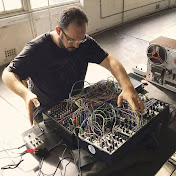
An accidental beat on the Euro Serge system. I guess it can make more regular sounding electronic music, too 😉 As always, this patch started with a couple of 'what if' questions. First, I was curious about the difference in sound between exponential and logarithmic slope as an oscillator, and how a wave multiplier could affect the sound of either. With a simple tone droning and a sequence running, I was reminded of the sound of Amon Tobin's classic parallel 10ths, so I patched another oscillator with the same sequence and tuned them, adding some slew on the CV for portamento. Interestingly, the two don't track perfectly together, because the slope has an exponential CV, but not 1v/oct, but the resulting diads sounded pretty nice anyway. I also realised I'd yet to use the ÷N COMP as a basic clock divider, so the slow sequence came out of a faster division, which I used for clocking modulation to the waveshape of the VCO II, and the wavemultipliers on the exponetial slope. I'm also using this base division to trigger filtered white noise for hats, with their decay and pan position randomly changing with modulation. The kick is the 1973 filter lowpass output fed back to the input, and enveloped through a VCA. I'm triggering this randomly through the shift register. Sending a regular clock, I'm sampling the random timing pulse from the RVG as my CV source, so sometimes there's a kick on the clock division, sometimes not. I'm also emulating sidechain compression manually, by flipping the kick envelope and feeding this to all other voices to duck them. Final voice is some noise through the phaser, which I then dirty up by feeding it back to itself. A fun patch.
Download
1 formatsVideo Formats
Right-click 'Download' and select 'Save Link As' if the file opens in a new tab.