QCM in PVD Explained
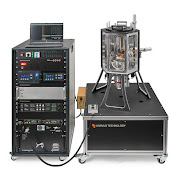
This video explains how a Quartz Crystal Microbalance (QCM) works and the reasons you may decide to use one in the thin film deposition process. Feel free to comment any questions you have about PVD or about Korvus' HEX series. If you want to learn more about Korvus and read about our products, you can view the links below: ⬡ Visit our site: https://korvustech.com ⬡ Learn more about the HEX: https://korvustech.com/thin-film-deposition-systems/ ⬡ Contact us: https://korvustech.com/contact-us Transcript: A Quartz Crystal Microbalance, or QCM, is a highly-sensitive device that measures mass changes on a quartz crystal surface. A QCM is widely used in Physical Vapour Deposition to monitor film thickness and deposition rates. The QCM is positioned in sight of the source but not to shadow the substrate. The quartz crystal vibrates at a certain resonant frequency when it is electrically stimulated, which changes as the mass of the crystal changes. This vibration can be around 6 MHz, or 6 million full vibrations per second! A quartz crystal monitor tracks changes in resonant frequency to measure the deposited mass. By providing the material’s density, the QCM can calculate the thickness of the material layer, and the rate of deposition. During the PVD process, the QCM provides real-time monitoring of the film thickness, allowing precise control over the deposition rate and total thickness of the coating. QCM data is used to adjust the deposition parameters such as power, pressure, and gas flow to maintain a consistent deposition rate. This control ensures that the desired film properties are achieved, improving the overall quality and uniformity of the coatings. Continuous monitoring ensures consistent film properties across batches by detecting deposition anomalies early, allowing for quick issue resolution before they impact final product quality. What are the advantages of Using QCM in PVD? The first is high sensitivity. The QCM is capable of detecting very small changes in mass, making it ideal for thin film deposition. You’ll also benefit from real-time monitoring of the deposition. You’ll receive immediate feedback during the deposition process. Additionally, this is non-invasive, so it won’t interfere with the PVD process while monitoring the deposition. Many people use a QCM in PVD for the cost benefits. A QCM helps in reducing material wastage by optimising the deposition process. And finally, it is very versatile. Unlike methods like in-situ ellipsometry, the QCM is appropriate for every kind of material. You can even introduce multiple QCMs- one for each deposition source- for co-evaporation processes. In PVD processes, the integration of a QCM is an indispensable tool for process control and optimisation, leading to enhanced film performance and reliability. At Korvus Technology, we’ve created the HEX Series of highly modular thin film deposition systems. The HEX series modularity allows for the addition of QCMs in any position. If you’re interested in what we have to offer, feel free to get in touch with us today and we’ll be happy to help.
Download
0 formatsNo download links available.