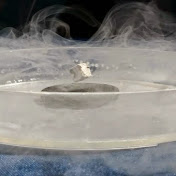
A 4.85 mm diameter water drop impacts a 2.85 mm thick static water layer at a velocity of 5.15 m/s and forms an impact cavity and crown. The drop Weber number, Reynolds number and nondimensional (i.e., h/D) layer thickness are 1,760, 24,900, and 0.6 respectively. Upon approaching the pinnacle of crown growth, it becomes unstable and secondary droplets are ejected. The crown then closes in on itself forming a large bubble having a size comparable to the original impact cavity. As the crown closes, the liquid at the top slowly runs down the side of the bubble to its base where it is deposited into the static water layer. The secondary droplets eventually fall back onto the closed bubble, yet they do not burst. Instead they are incorporated into the liquid film. Eventually the bubble bursts, due to thinning of the bubble wall and upon impact with the water layer entrains several small air bubbles beneath the original cavity location. This video, which was recorded at 10,000 frames per second and played back at 180 frames per second, has been provided courtesy of Professor John Kuhlman of West Virginia University.