Role of Deduction
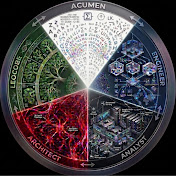
The Role of Deduction in Logical Inquiry Deduction serves as the gold standard of certainty within the "theory of inquiry," acting as the engine that guarantees a conclusion if its starting premises are true. Unlike its partner, induction, which deals in the messy world of probability and "more or less" evidence, deduction is strictly truth-preserving. This means that in a valid deductive argument, the "anatomy" of the logic is so tight that it is impossible for the premises to be true while the conclusion is false. By focusing on the logical form—the skeleton of the thought—deduction allows us to strip away the distractions of specific subject matter and evaluate the "necessity" of a claim. Whether we are discussing the spires of a cathedral or the internal structure of an atom, deduction ensures that we are not just making lucky guesses, but following an unbreakable chain of reasoning. The Scientific Bridge: From Theory to Observation In the practical world of empirical science, deduction acts as the essential bridge between unobservable theories and observable facts. Because we cannot "directly inspect" things like the internal structure of a Bohr atom or the specific sequence of a gene, we must use deduction to find the logical implications of our hypotheses. This is the core of the Hypothetico-Deductive Method: we take a general assumption, conjoin it with specific "initial conditions," and deduce a consequence that can actually be tested in a lab. If a physicist predicts a specific spectral line based on a theory, they are using deduction to turn an invisible idea into a visible target for observation. Without this deductive "translation," scientific theories would remain trapped in the realm of abstract speculation, unable to ever be "confronted with the outcome of observation." Clarifying Meaning and Exposing Bias Beyond its role in the lab, deduction performs a vital normative function in human affairs such as law and medicine. As Justice Oliver Wendell Holmes famously noted, general principles do not decide individual cases on their own; they require the rigorous application of deductive logic to "lay bare" the underlying assumptions of a decision. By exhibiting the deductive structure of a legal argument or a medical diagnosis, we are forced to be explicit about our premises. This process often reveals the "invisible engines" of bias or inconsistency that might otherwise remain hidden in vague language. When we deduce the consequences of a "protective tariff" or a "medical treatment plan," we are not just calculating facts; we are clarifying the very meaning of our convictions and ensuring that our "reflective and responsible thought" is actually consistent. The Complementary Nature of Deduction and Induction It is a common mistake to view deduction and induction as antagonistic forces, but in a complete "system of knowledge," they are complementary partners. Deduction exploring the consequences of our various assumptions, while induction judges the "adequacy" of the evidence we have for those same assumptions. While deduction is a "closed system"—meaning it cannot discover a new fact that wasn't already hidden in its premises—it is the only tool we have for systematizing our knowledge into a coherent whole. By incorporating isolated observations into a "comprehensive deductive system," we broaden the "common reservoir of evidence" for everything we know. This creates a "consilience" where an experiment with a pendulum can indirectly provide evidence for the laws of the tides, all because the two are linked by the same deductive chain.
Download
1 formatsVideo Formats
Right-click 'Download' and select 'Save Link As' if the file opens in a new tab.